Action Centred Leadership
John Adair
Introduction
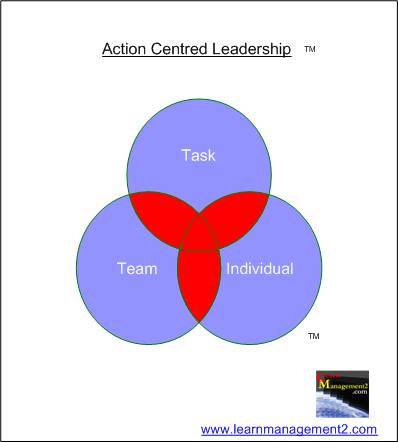
Leadership theorist John Adair devised his Action Centred Leadership Model following observations of leaders and their followers during the 1970s. Under this theory leaders are responsible for three functions; the task, the individual and the team. Adair captured his theory in a three circle diagram; in which each of the circles overlapped.
The diagram below captures the 3 essential components in Adair's Action Centred Leadership Theory
The diagram above has been reproduced with the kind permission of John Adair & Adair International Ltd http://www.adair-international.com and http://www.johnadair.co.uk/ .
Interdependent Functions
The three overlapping circles illustrate that each of the functions
are interdependent. This is because individuals make up teams, teams/individuals complete tasks and without a task there is no need for a team or individual. If one element is missing or weak then the other elements will suffer. For example if the team is weak then the task will suffer and one weak
individual can affect team performance and subsequently task completion.
Adair said that leaders should therefore concentrate on:
- Task Completion (achieve the task)
- Creating and sustaining a group of people that work together as a team (build and sustain a team) and
- Development of individuals within the team (develop the individual).
Leadership Functions
Adair stated that the three objectives of task, team and individual can be achieved through the following actions. These are often referred to as leadership functions.
Defining all tasks
so that goals and objectives are SMART (Specific, Measurable, Achievable, Realistic and Time-Constrained). see www.learnmarketing.net/smart.htm
Regular team briefings
so that the team are aware of tasks and progress. Team briefings are a form of communication and can therefore be used to motivate the team.
Motivating
is a key leadership function because successful and efficient task completion is dependant on motivated teams.
Organising
If a leader does not organise the task and team resources will be wasted and efficiency compromised.
Planning
Tasks need to be planned so that both the team and leader are aware of objectives, time scales and individual responsibilities. Planning should include contingencies to cater for unexpected events include testing of the plans. Evaluations: A leader should constantly evaluate prior to, during and after events. This should include an evaluation of performance, training for individuals and lessons from previous experiences.
Control
A leader needs to control a number of areas including maintaining overall control of the project, implementation of good control systems, and they need to possess self control.
Delegation
A leader also needs to delegate tasks effectively and monitor the teams skills to increase efficiency and “value for money”. Adair believed that an “excellent leader” achieved maximum results through the use of minimum resources.
Lead by example
If a leader does not lead by example this will affect their credibility and influence. If a team do not believe that their leader believes in the their objectives then they will lose motivation
Leadership Can Be Taught
Adair firmly believed that leadership can be taught and that a person can become a successful leader through effectively applying the action centred leadership model. This opinion was a departure from the other theories prevailing at the time (1960s) which stated that people are born with leadership characteristics and therefore leadership cannot be taught.
Conclusion
Nowadays Adair’s theory is either criticised for being “too simple” and branded as outdated, or welcomed by those who feel that it’s simplicity and practicality render it timeless; the model is being used successfully in many organisations today, including global financial institutions, international biotech companies, law firms and government departments