

Organisational Culture
Introduction
When we walk into an organisation we often get a 'feeling' about it; whether it feels fast moving and responsive, or old and backward looking, this 'feeling' is referred to as the 'organisational culture'. Culture is about how a firm organises itself; rules, procedures and beliefs make up the culture of a company. In this section we are going to briefly look at six types of organisational cultures; power, role, task and person cultures were described by Charles Handy in his 1981 book Understanding Organisations.
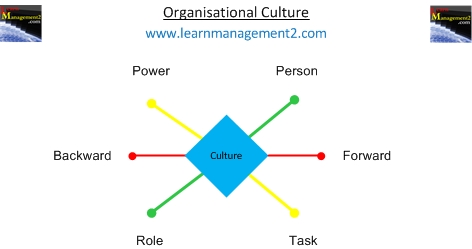
The diagram below captures six types of organisational culture;power culture, person culture, backward looking culture, forward looking culture, role culture and task culture.
Power Culture
For a Power Culture firm control is the key element, decisions are made by one or a small number of people. Power cultures are usually found within small organisations or a section/department belonging to a large organisation. This is because it would be difficult to run a large organisation where only a small number of people were allowed to make decisions. In a power culture organisation, decisions can be made quickly as there is little consultation. However lack of consultation could mean that a firm is not able to take advantage of the skills and experience of its workforce; it could even lead to employees feeling demotivated and high staff turnover. Ultimately the success of a power culture firm will depend on the strength of the decisions made by its founders/decision makers.
Role Culture
In a Role Culture organisation, individuals are assigned a specific role or job. They may have a job description listing the tasks they are responsible for. Role culture enables large organisations to spread tasks among their employees and ensure key tasks are covered without unnecessary duplication. This is particularly useful for specialist roles e.g. sales, marketing, project management and legal compliance. Specialist roles should increase productivity as employees are completing tasks they are fully trained and experienced to do. However a role culture may be unsuitable for organisations with a small number of employees where everyone needs to be take on a variety of tasks and responsibilities. Furthermore a role culture organisation may find it difficult to adapt, if its staff are controlled by tight systems and procedures.
Task Culture
Task culture refers to the use of teams to complete tasks especially if the task/objective has a number of steps. The establishment of project teams for the completion of specific objectives/plans is an example of task culture. Project teams will be set specific tasks to complete within a set timescale and budget. A task culture has a number of benefits; staff feel motivated because they are empowered to make decisions within their team, they may feel valued because they have selected for the team and their is a sense of achievement when the team complete the task successfully. It may also allow teams to be more creative when problem solving.