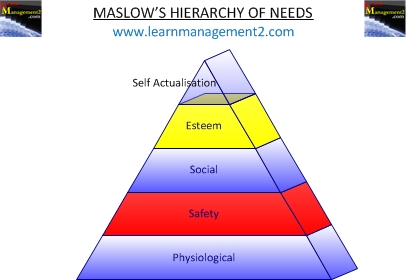
Abraham Maslow a US psychologist, developed the well known 'Hierarchy of needs' motivation theory. Under this theory Maslow suggests that everybody has a series of needs and these needs can be organised into a hierarchy of priority. Maslow also stated that if you want to motivate an individual you will need to know which of their needs have been satisfied. Once you have this information, you can decide which need has to be satisfied in order to motivate your subject.
The diagram below illustrates the five needs in Maslow's Hierarchy of Needs in the order of priority designated by Maslow
Hierarchical Levels
Maslow divided employee needs into five needs;
Physiological needs
Safety needs
Social needs
Esteem needs and
Self actualisation needs
Maslow assessed the priority of each need to employees and placed them in a hierarchy based in the order that each need should be satisfied.
Why Are Maslow's Hierarchy Of Needs Called A Hierarchy
Maslow asserts that needs at the bottom of the hierarchy must be met first; a person is unable to focus on the higher levels needs until the bottom level needs have been satisfied. For example until an individual's physiological needs have been met, they will be unable to move onto safety needs, once safety needs have been met the individual can move onto social needs and so on. Under this theory Maslow states that as people continuously strive for personal achievement, the need for self actualisation is ongoing and will never be satisfied.
Application of Maslow's theory within the workplace
The table below provides examples of how Maslow's "Hierarchy of Needs" theory can be applied in the work place.
Maslow's Need
Examples of How The Need Can Be Met In The Workplace
Physiological
A salary amount which enables the individual to have food, shelter and clothing
Safety
Safe working conditions and clear work procedures to reduce stress and anxiety
Social
Positive work relationships, team work and work social events to encourage team building
Esteem
Appraisals, 1 to 1s and other achievement recognition programmes. The opportunity to achieve and secure job promotions
Self Actualisation
Allocating challenging and stimulating responsibilities to employees. Employee development plans to help employees reach their potential in the workplace
Conclusion
Although Maslow's Hierarchy Of Needs theory is a popular theory it should applied with caution, especially as there is little statistical evidence to support it. Upon application it may be difficult to assess which of the needs (in the hierarchy), have been met for a particular individual. Each person may require different things to satisfy their needs, for example one individual's view of what is adequate shelter may differ from another person's view. There is also debate over the order in which the higher level needs have been placed in the Hierarchy of Needs. A person's life experience may alter their Hierarchy of Needs. Some people may require esteem needs satisfaction before social needs satisfaction. Furthermore not everybody displays a need for self actualisation and progression and they may be satisfied by achieving just the other needs. How do you think the rise in social media has affected Maslow's Hierarchy Of Needs.
Studying Business Management visit www.learnmanagement2.com