

Scientific Management
Frederick Winslow Taylor
Introduction
Scientific management is the brainchild of Frederick Winslow Taylor. In its simplest form the theory asserts there is one best way to do a job and scientific methods can be used to determine that "one best way"
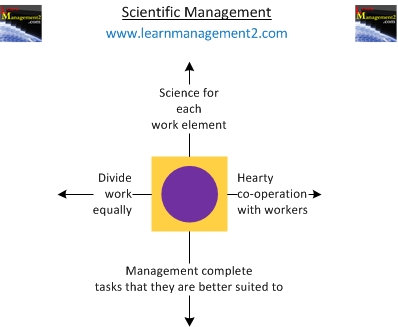
This diagram captures the 5 scientific management guidelines from Taylor's Scientific Management Theory
Taylor developed his theory through observations and experience as a mechanical engineer. As a mechanical engineer Taylor noticed that the environment lacked work standards, bred inefficient workers and jobs were allocated to people without matching the job to the worker's skill and ability. In addition to this the relationship of the workers with the managers included many confrontations.
Scientific Management Guidelines
Over a 20 year period Taylor devised the "one best way" to do each of the jobs on the shop floor. He then concluded that prosperity and harmony for both workers and managers could be achieved by following the five guidelines below:
- Develop a science for each element of an individual's work, which will replace the old rule of thumb method.
- Scientifically select and then train, teach and develop the worker.
- Heartily cooperate with the workers so as to ensure that all work is done in accordance with the principles of the science that has been developed.
- Divide work and responsibility almost equally between management and workers.
- Management takes over all the work for which it is better fitted than the workers (rather than most of the work and responsibility being assigned to the workers).