
Tall Structure Organisation
In its simplest form a tall organisation has many levels of management
and supervision. There is a “long chain of command” running
from the top of the organisation eg Chief Executive down to the bottom of the organisation
eg shop floor worker. The diagram below neatly captures the
concept of a tall structure.
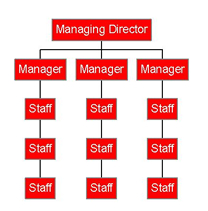
Diagram: Tall Structure

However, tall structures rarely exceed 8 levels of
management. This is firstly because the number of layers (i.e. management
levels) decreases the span of control. Secondly the disadvantages of
the tall structure begin to outweigh the advantages of a tall
structure.
Advantages
of tall Organisations |
Disadvantages
of tall Organisations |
- There is a narrow span of control ie
each manager has a small number of employees under their control.
This means that employees can be closely supervised.
|
- The freedom and responsibility of employees (subordinates) is
restricted.
|
- There is a clear management structure.
|
- Decision making could be slowed down as approval may be needed
by each of the layers of authority.
|
- The function of each layer will be clear and distinct. There
will be clear lines of responsibility and control.
|
- Communication has to take place through many layers of management.
|
- Clear progression and promotion ladder.
|
- High management costs because managers are generally paid more
than subordinates. Each layer will tend to pay it’s
managers more money than the layer below it.
|