

Hierarchical Structure
Introduction
In a hierarchical organisation employees are ranked at various levels within the organisation, each level is one above the other. At each stage in the chain, one person has a number of workers directly under them, within their span of control. A tall hierarchical organisation has many levels and a flat hierarchical organisation will only have a few. The chain of command i.e. the way authority is organised) is a typical pyramid shape.
The diagram below shows a traditional hierarchy; senior managers make up the board of directors and are responsible for establishing strategy and overall business direction, whilst middle managers have responsibility for a specific function such as finance or marketing.
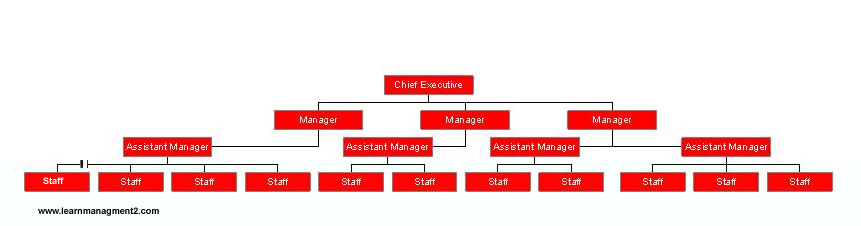
Chain Of Command and Employee Roles
A traditional hierarchical structure clearly defines each employee's role within the organisation and defines the nature of their relationship with other employees. Hierarchical organisations are often tall with narrow spans of control that get wider as we move down the structure or narrower as we move up the organisation's structure. Hierarchical organisations are often centralised so the most important decisions are taken by higher management.
Technology And Hierarchical Structure
In the past hierarchical structures were viewed by organisations as an effective way to control employees within larger organisations. However since the 1990s, (in line with technology improvements) companies have reduced the size of their workforce by using technology to complete many of the functions previously completed by humans.